 Skip to main content
What Is Three-Phase AC Power? A Guide to Power Conversion and Applications
Three-phase AC power is widely used in industrial, commercial and higher-power electrical systems because it delivers electrical power more efficiently and consistently than a single-phase supply. Although it is often associated with large motors and industrial machinery, many modern electronic systems rely on three-phase power as the starting point for a much wider power conversion architecture.
For many applications, the main question is not simply whether three-phase power is available. It is how that supply will be used within the wider system. In equipment such as industrial machinery, EV charging infrastructure, automation panels, telecommunications systems and larger power supply assemblies, AC power may be rectified, regulated and converted again before it reaches the loads that need a stable DC voltage.
This is where power supplies and converters become important. Although a three-phase supply provides the incoming electrical power, power supplies and converters create the stable DC voltages needed by the equipment.
What Is Three-Phase AC?
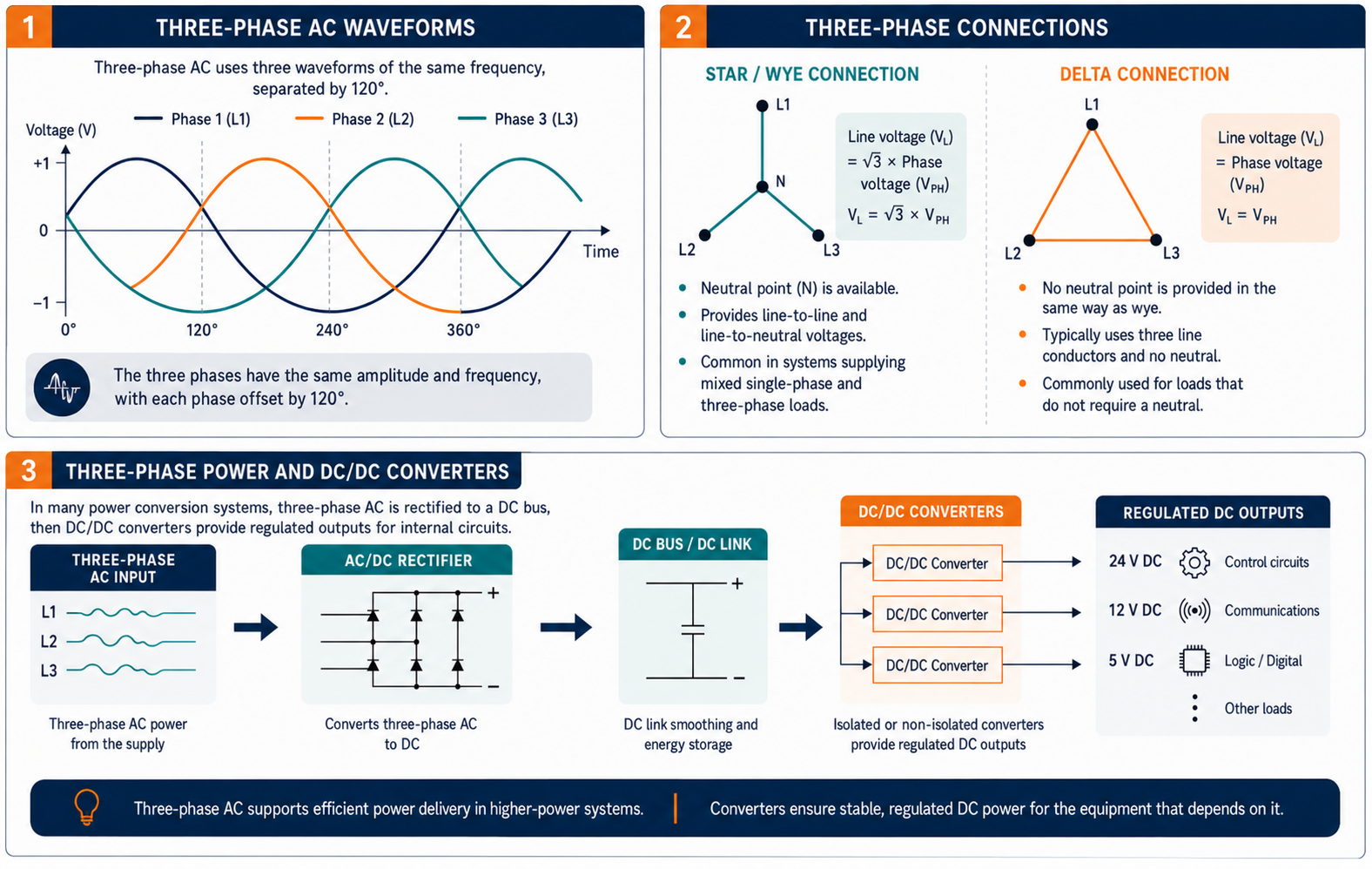
Three-phase AC is an alternating current system made up of three separate AC waveforms. Each phase operates at the same frequency, but the waveforms are offset by 120 degrees.
In a single-phase system, there is one AC waveform. This is common in residential properties and smaller electrical installations. In a three-phase system, the three phases rise and fall at different points in the cycle. When one phase is near its peak, the other two phases are at different positions, which helps create a more continuous power supply.
This smoother delivery is one reason three-phase power is used for equipment with higher or more consistent power demand. It is especially useful for motors, pumps, compressors, HVAC systems, production machinery, lifts, data centres and commercial electrical distribution.
Single-Phase Power vs Three-Phase Power
Single-phase power is typically used for lower-power applications. In the UK, most homes use a single-phase supply, which is usually suitable for lighting, domestic appliances, electronics and smaller loads.
Three-phase power is used where the demand is higher, where large motors are involved, or where power needs to be distributed more efficiently across a site or system. Unlike single-phase power, which relies on one phase, three-phase power uses three live conductors. Depending on the installation and configuration, there may also be a neutral wire.
The difference is not only about having more power available. Three-phase power can deliver power more consistently, which helps reduce the peaks and dips seen in single-phase systems. This is useful in industrial and commercial environments where equipment needs to run reliably for long periods.
For example, a three-phase motor can produce smoother torque than many single-phase motor arrangements. This makes three-phase systems common in conveyors, pumps, fans, compressors and other equipment used in industrial operations.
How Does a Three-Phase System Work?
In a balanced three-phase system, the loads across the three phases are similar. This helps the system operate efficiently and reduces unnecessary current in the neutral wire.
The three phases can be connected in different ways, with the two most common being star, also known as wye, and delta. In a star or wye connection, one end of each phase is connected to a shared neutral point. This can provide both line-to-neutral and line-to-line voltages, making it useful where a system needs to support a mix of single-phase and three-phase loads.
In a delta configuration, the phases are connected in a loop. This arrangement usually uses only three wires and does not provide a neutral in the same way as a wye system. Delta connections are often used where the load is entirely three-phase, such as certain motors, transformers and industrial equipment.
The chosen configuration affects the voltages available, how equipment is connected and the type of power conversion equipment required within the system.
Line Voltage, Phase Voltage and the Neutral Wire
Three-phase specifications often refer to line voltage and phase voltage. Line voltage is measured between two phases. Phase voltage is measured between one phase and neutral.
In many UK low-voltage systems, this is commonly described as 400 V between phases and 230 V between a phase and neutral. This is why a supply may be described as 400 V three-phase while still providing 230 V single-phase loads from one phase and neutral.
The neutral wire is important when the system supplies phase-to-neutral loads or when the installation includes a mix of single-phase and three-phase equipment. In a balanced system, very little current may flow through the neutral. In an unbalanced system, the neutral can carry more current, which is why load balancing matters in commercial and industrial installations.
For power supplies and converters, the available input arrangement matters. A converter designed for one input range or phase connection should not be assumed to suit another without checking the datasheet and the wider system design.
Where Is Three-Phase Power Used?
Three-phase power is widely used by OEMs, machine builders, manufacturers and system integrators where equipment has higher or continuous power demands. It is common in factories, workshops, commercial buildings, HVAC systems, lifts, production lines, large charging systems, data centres and industrial automation.
In the industrial sector, three-phase systems are useful because they can support high-power equipment such as conveyors, compressors, pumps and machinery. In commercial buildings, they help distribute power across larger loads such as lifts, heating, cooling, lighting and plant rooms. In data centres and telecommunications environments, three-phase distribution can help balance demand across racks, cooling systems, UPS units and power distribution equipment.
Three-phase power is also becoming more relevant in some residential and mixed-use settings, particularly where there are high-demand loads such as EV chargers, heat pumps, workshops or multiple electricity meters. Most homes still use single-phase power, but larger properties and apartment buildings may require a different supply arrangement.
Why Three-Phase Power Matters for Converters
Modern equipment often does not use incoming AC power directly. Instead, it is rectified into DC before being regulated into the different voltages required by the system.
In a simplified three-phase power architecture, the three-phase AC input may be rectified to create a DC bus. From that point, DC/DC converters can be used to produce stable output voltages for lower-power internal circuits. These may include 5 V, 12 V, 24 V or other regulated DC outputs used by controllers, sensors, communication modules, displays, relays, safety circuits and monitoring equipment.
For example, a production machine may receive a 400 V three-phase AC supply. After rectification to a high-voltage DC bus, DC/DC converters generate regulated 24 V DC for PLCs, 12 V DC for communication modules and 5 V DC for sensors and control electronics.
This matters because the main three-phase supply may be stable, but the equipment can still fail if the internal DC rails are poorly specified. Voltage dips, ripple, electrical noise, heat, transient loads or unsuitable converters can lead to resets, communication faults, nuisance trips or unreliable operation.
For this reason, converter selection should not be left until the end of a design. Input voltage range, isolation, output voltage, load current, efficiency, derating, thermal performance and EMC requirements should all be considered early in the design process.
DC/DC Converters in Three-Phase Systems
DC/DC converters are used when one DC voltage needs to be converted into another regulated DC output. In systems fed by three-phase AC, they are often found after the AC/DC conversion stage, where they help distribute stable DC power to different parts of the equipment.
For example, an industrial control panel may receive power from a three-phase supply, but its control electronics may still need regulated 24 V DC, 12 V DC or 5 V DC. A larger machine may use three-phase power for motors and drives, while separate DC/DC converters provide stable power for sensors, communications and safety controls.
Our DC/DC converter range includes DIN rail, enclosed and PCB mount formats, helping support different installation and integration requirements. These converters are commonly used in applications such as industrial automation, telecommunications, embedded electronics and instrumentation, where consistent voltage regulation is important.
What to Check Before Choosing a Converter
The first step is to understand the system’s power architecture. Is the converter powered by a DC bus, a battery, a rectified AC input, or another regulated DC supply? The answer affects the input voltage range and the type of converter required.
The next step is to confirm the output voltage and current. A converter should be sized for the real load, including any start-up demand or short transient peaks. Efficiency, heat, available airflow and derating should also be considered, especially when the converter is installed inside an enclosure or close to other heat-generating components. The required safety approvals should also be confirmed, particularly for industrial, medical, railway or telecommunications applications.
Isolation may also be required. Some systems need isolation for safety, noise reduction or separation between different parts of the circuit. Other applications may prioritise a wide input range, compact PCB mounting, DIN rail installation, low ripple, EMC performance or long-term availability.
In three-phase applications, these decisions are often linked to the wider system rather than the converter alone. The incoming supply, rectification stage, DC bus, protection devices, cable lengths, earthing and load behaviour can all influence the final specification.
Why Choose Ideal Power?
Ideal Power helps OEMs, equipment manufacturers and design engineers specify, source and supply power conversion products for commercial and industrial applications. Our range includes AC/DC power supplies, DC/DC converters, LED drivers and battery chargers, supported by technical expertise from product specification through to supply.
In projects involving three-phase power, the converter is only one part of the system. We can help assess input requirements, DC output voltage, current rating, isolation, efficiency, form factor, approvals, availability and integration needs, so the selected product is suitable for the real operating environment.
This is particularly useful where reliability, compliance or long-term supply are important. By considering the conversion architecture early, it is easier to reduce the risk of redesign, supply issues or performance problems once the equipment is built.
Summary
Three-phase AC power uses three alternating phases offset by 120 degrees. This allows it to deliver power more smoothly than single-phase power, making it well suited to industrial equipment, motors, commercial buildings, data centres, HVAC systems and higher-power electrical installations.
For power conversion projects, three-phase power is often only the start of the architecture. The incoming AC may be rectified into a DC bus, then converted again using DC/DC converters to provide stable voltages for internal circuits.
Selecting the right converter depends on the full system, including input voltage, output voltage, load current, isolation, efficiency, thermal conditions and compliance requirements. Selecting the correct converter early in the design process helps improve reliability, reduce redesigns and ensure stable power throughout the finished system.
