 Skip to main content
The EV charger internal power supply determines whether a charger operates reliably under real-world conditions. Electric vehicle chargers rarely fail because engineers misjudge the high-power stage; more often, failure begins when the low-voltage architecture is treated as secondary.
Inside every EV charger, the EV charger internal power supply controls stability. It governs communication integrity, protection logic and overall system safety. When this stage is under-specified, chargers overheat, reset under load, fail EMC testing or behave unpredictably in the field.
For that reason, reliable EV charging starts with disciplined power architecture, and that discipline must include the DC/DC stage.
The Overlooked Risk in EV Charger Design
EV charging systems operate across three structural layers. On-board chargers sit inside the vehicle and convert AC to DC within strict thermal and space limits. Off-board chargers relocate high-power conversion into the cabinet. Supporting infrastructure manages grid interface, protection and communication.
In rapid DC chargers, engineering attention focuses on kilowatt ratings, switching devices and thermal control. These stages carry charging current. They dominate efficiency discussions.
Yet behind the high-power stage sits the low-voltage architecture that maintains control. In practice, this layer determines whether the charger behaves consistently under stress.
The internal DC/DC stage generates regulated rails such as 5 V, 12 V or 24 V. These rails power microcontrollers, communication modules, HMIs, relays, contactors, cooling systems and safety circuits. They do not deliver charging current. Instead, they ensure predictable operation.
When this stage destabilises under thermal rise or electrical noise, control integrity declines. As a result, the system becomes unstable even if the high-power stage continues to function.
How AC/DC and DC/DC Stages Drive Charger Performance
Understanding AC and DC in EV charging begins with a simple distinction. The grid supplies alternating current. EV batteries store direct current. Every charger must bridge that gap. Consequently, architecture choices shape long-term reliability.
In DC chargers, grid AC converts into high-voltage DC inside the cabinet. This creates a DC bus that feeds downstream stages before power reaches the battery. In AC wallboxes, the vehicle performs the main AC/DC conversion through its onboard charger. Even so, the charge point still contains internal conversion stages for control electronics.
Where AC/DC conversion occurs within the charger, the front end rectifies mains AC into controlled DC. It usually includes Power Factor Correction to manage harmonics. From this DC bus, downstream DC/DC stages step voltage down into tightly regulated low-voltage rails.
These rails, typically 5 V, 12 V or 24 V, support controllers, communication modules, displays, cooling systems and protection relays. Therefore, their stability directly affects regulation accuracy, noise behaviour and long-term reliability.
When these rails drift or fluctuate, the effect is immediate. Controllers reset, communication drops and charging sessions terminate unexpectedly. In high-power environments with thermal and EMC pressure, disciplined DC regulation becomes essential.
What Goes Wrong in Practice
High-power EV chargers operate in demanding electrical conditions. Sustained duty cycles generate heat inside compact enclosures. Without proper derating in the DC/DC stage, capacitor ageing accelerates. Ripple increases, voltage regulation begins to drift and, under transient load, resets occur.
At the same time, the front-end AC/DC stage generates high-frequency switching noise. If isolation and ripple suppression in the DC/DC layer are weak, that noise reaches logic rails and communication circuits.
As a result, design teams see predictable outcomes. EMC tests fail. Conducted emissions exceed limits. CAN or Ethernet links destabilise. Protection circuits trigger unexpectedly. Prototype revisions follow.
These issues rarely originate in the high-power stage. Instead, they stem from weak low-voltage stability.
Power Quality Extends Beyond the Cabinet
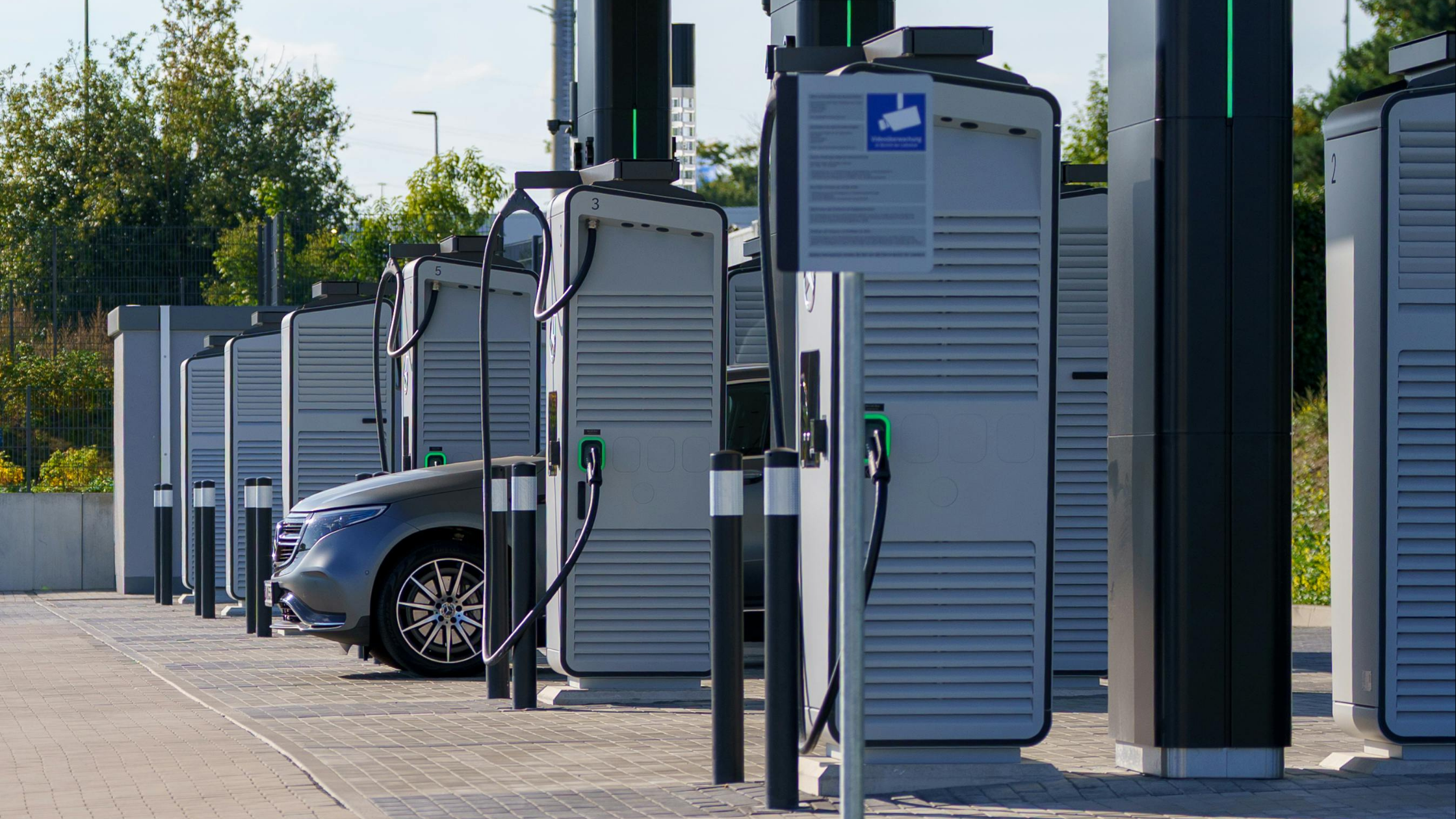
EV charging systems connect directly to the low-voltage distribution network. Therefore, harmonic distortion and voltage stability extend beyond the enclosure.
A 2025 peer-reviewed study in Energies examined grid-connected EV charging stations. It showed that harmonic distortion can fall significantly through optimisation of transformers, filters and capacitor banks. In simulation, voltage total harmonic distortion dropped to 0.05 percent. Grid current THD fell to 0.88 percent after mitigation techniques were applied.
The message is direct. Charger performance depends on system-level power architecture. Within that structure, the EV charger internal power supply plays a defining role. Stability must be engineered at every stage. Inside the charger, that responsibility rests with the DC/DC layer.
The DC/DC Converter as the Stability Anchor
A properly specified DC/DC converter does more than reduce voltage.It stabilises the control layer across DC bus variation and maintains regulation accuracy at elevated temperatures. In addition, effective ripple suppression and proper isolation protect sensitive electronics from switching noise.
As a result, it prevents transient disturbances from reaching control circuitry.
When DC/DC selection is weak, instability follows. Control boards reset. Communication drops out. Nuisance trips increase. Service returns rise. Although these problems appear at system level, the root cause often lies in the low-voltage stage.
Designing the EV Charger Internal Power Supply at Concept Phase

Mechanical layout and charging capacity often dominate early discussions. Meanwhile, low-voltage architecture is defined later. That sequence creates avoidable risk.
The DC/DC stage should be specified during concept development alongside the AC/DC architecture. Engineers must assess DC bus input range, isolation level, output tolerance, transient load demand, ambient temperature and EMC constraints from the outset.
By selecting a high-reliability DC/DC converter early, PCB rework reduces. Filtering simplifies. Thermal margins stay intact before compliance testing begins.
If you are integrating control electronics within an EV charger, the DC/DC stage is a design-critical decision. In practice, long-term stability depends on how the EV charger internal power supply is defined at concept stage.
Why Wide Bandgap Is Gaining Ground
Wide bandgap devices such as GaN and SiC switch faster and operate with lower losses than traditional silicon components. As a result, EV charging systems achieve higher efficiency, reduced heat and increased power density.
These benefits matter most in high-power AC/DC and isolated DC/DC stages. Higher switching frequencies shrink magnetics and filtering components. Lower losses reduce thermal pressure inside compact cabinets.
Where wide bandgap devices support the charger’s conversion architecture, they improve efficiency margins and long-term stability. In lower-power auxiliary rails, silicon solutions may still suit the application.
Charger Reliability Begins at the Low-Voltage Stage
Thermal stress, harmonic distortion, EMC failure and field instability often trace back to decisions made in the low-voltage stage.
High-power conversion attracts attention, yet internal DC/DC architecture ultimately determines whether the charger behaves consistently in real operating conditions.
Reliable EV charging does not begin at the connector. It begins with a correctly specified EV charger internal power supply defined early in the design process.
